Showing posts with label museums. Show all posts

17 April 2026

some of the others

These are a few of the other mushrooms that have appeared in our pasture and back yard this past week.

Sailor Fude de Mannen fountain pen (De Atramentis Document brown ink), watercolor background, and gouache in a Seawhite Travel Journal.


22 May 2022

San Felipe de Austin


We took time out from camping to visit the nearby San Felipe de Austin’s history museum with a “Villa de Austin” recreation of some of the town’s buildings. The actual township’s location is across the highway where archeological digs are ongoing. This town was designed and established by Steven F. Austin in 1823-1824 and served as his colonial capital when Texas was still part of Mexico. Townspeople destroyed the town themselves as General Santa Anna advanced on those fighting for Texas independence.

Drawn with a Kaweco Liliput fountain pen loaded with J. Herbin Lie de The ink which blurs a bit when watercolor is added, causing an “antique” look.

31 May 2018

one more from the Cavalla, plus . . .


When Bill was in the navy, he was a machinist on board the submarine tender, U.S.S. Sperry. So when I saw this machinist’s lathe on the submarine Cavalla, I had to draw it! I remember Bill coming home from the ship with wee bits of metal shavings stuck to his uniform — going barefooted was risky! But he enjoyed the creativity involved in making repair parts for submarines, many times succeeding when his chief said it couldn’t be done!

This is the final two-page spread in the single-signature sketchbook I made of smooth Bristol paper. It records memory sketches from Battleship Texas, the Cavalla, and the very last sketch is from the only photo I remembered to take on the U.S.S. Stewart, a destroyer escort. This little book is for Bill . . .

. . . and after so many ink sketches in a row, I am So Ready to get back to watercolor!

30 May 2018

U.S.S. Cavalla, part 3


The junior officer’s berthing on the left was already posted previously, but on the right I have added a very confusing ink sketch of the control room aboard the Cavalla submarine. At least that’s what I’m calling it; not sure what the Navy calls it. I think I only got half of the dials and levers in!

Up the ladder was the bridge, periscopes, and attack center — at least that’s what the sign read — but the way was blocked. Causing a wee grump out of Bill, who wanted to go up there.

28 May 2018

U.S.S. Cavalla, part 2


So how would you like to bunk atop a torpedo? On this World War II submarine, as on most subs, bedding was crammed in every available space. I like the complicated table in the officers’ mess, drawn on the above right page. Apparently it was also used to study maps or charts.

This is one of the junior officers’ quarters. There were two beds n this long, narrow space with a desk at each end. My eyes went immediately to the gorgeous leather-bound journal laying on the pillow!


26 May 2018

U.S.S. Cavalla


Seawolf Park on Pelican Island, next to Galveston, is the permanent home of the U.S.S. Cavalla, a World War II submarine of the Gato class. It is similar in size to the U.S.S. Seawolf, a Sargo class submarine that the park is named for. The Seawolf was lost at sea, probably under friendly fire.

Bill served on a submarine tender in the 1970s, and worked on many WW II subs as well as newer nuclear subs. He had been aboard them many times, machining specially-fit replacement parts, but this is the first time I’ve been on one.

24 May 2018

Battleship Texas, part 3


Just a couple more sketches from the U.S.S. Texas battleship . . .

The bell from the original Battleship Texas is below decks. The second Texas still retains her bell hanging in place above decks. The first Texas was commissioned in 1895; she was renamed San Marcos in 1911 which allowed this second ship to be named Texas.

The first U.S.S. Texas had a reputation of being a jinxed ship after several early mishaps. She served in the Spanish-American War and later became a station ship in Charleston, South Carolina. After being renamed, she became a target ship for gunnery practice.

The bridge sketches were from a badly backlit photo Bill took — sunlight was pouring through those portholes and the brightness even hurt my eyes just looking at the photograph! So details are not absolutely correct, but I wanted to draw the wheel and show what tiny visibility there was looking through the portholes that ran a half-circle around this room. Bill says this tiny space would have been a tight squeeze for the many officers present. There was a table to the left where maps were spread out to study.

23 May 2018

Battleship Texas, part 2


A couple more pages from Bill’s memory book, a bit of everyday life for the sailors.

21 May 2018

Battleship Texas


This single signature sketchbook contains smooth Bristol paper that works best with pen and ink. Following our recent trip to La Porte and Seawolf Park on Pelican Island (next to Galveston), I decided to use this book for memory sketches of the three Navy vessels we explored. A special memory book for Bill who served in the Navy in the early 1970s — he was like a little kid as he climbed up, down, and all around the battleship, submarine, and destroyer escort!


The first pages are of Battleship Texas, formerly known as USS Texas BB-35, which is moored next to the San Jacinto Monument and Battleground in La Porte, Texas. All these sketches are done from photos we both took with our phones; the upper sketch of the ship is as viewed over the ridge from the parking lot. I planned on drawing it at the diner down the road as Bill and his buddies met for coffee . . . then realized that I had forgotten to bring a pencil for the loose undersketch. So I dived in with my Lamy Safari pen, loaded with a dark gray ink. Scary to go pencil-less!


We went up and down LOTS of these steep ladder stairs and our knees complained a bit! I teased Bill about how he used to practically fly down these things on the USS Sperry, sliding down the handrails. But that was over 40 years ago. You would think we’d be used to them — our log cabin stairs to the loft are just as steep.

16 May 2018

museum bits; a chimney in want of a building


On some of the last pages of this small travel journal I drew some small bits from the museum exhibit at San Jacinto. There were many other artifacts from previous civilizations but most seemed a bit daunting to sketch. And while I was tempted to sketch a life-sized bust of Sam Houston, I ended up drawing a few of his personal belongings instead — somehow, they seem more poignant.


In downtown Galveston, I found this old chimney standing strong, though the building was long gone. Not sure what type of business or factory it was.

discovering another sketching journal keeper


While at the San Jacinto Monument, I discovered a sketching journal keeper . . . and a bit of a rogue! Sam Chamberlain was a soldier during the Mexican-American War that followed soon after Texas won her independence; one outcome of this conflict was America gaining New Mexico, Arizona, and California territories.

Chamberlain kept a sketchbook with him and later did a large number of watercolors from his sketches and memories. Instead of recording them in a bound sketchbook, he often wrote down his memories on the backs of the small paintings.

He later wrote and illustrated his recollections . . . greatly embellished by imagination . . . and eventually his descendants sold the rights to Life magazine. The largest collection of his work can be found at the San Jacinto Monument.


05 May 2018

San Jacinto

Bill and I both love history museums; in fact I once worked in one in Kansas. When our daughter moved to Houston she took us to see several, including the San Jacinto Monument, but it was so long ago we decided to go again.

It was here in 1836 that volunteer Anglo-Americans and Tejanos defeated Santa Anna’s much larger army, gaining independence for Texas. 

The monument was built during the Great Depression to commemorate the 100 year anniversary, mostly out of fossilized Cordova Cream shellstone — I enjoyed looking at the stone as much as the exhibits!

We happened to arrive just as several school buses of noisy, undisciplined children also arrived. We tried going through the exhibit covering 400 years of Texas history but it was just too loud and hard to see much while dodging kids.
We happened to arrive just as several school buses of noisy, undisciplined children also arrived. We tried going through the exhibit covering 400 years of Texas history but it was just too loud and hard to see much while dodging kids.S

So we left the monument and headed to the nearby USS Texas battleship. Just as we finished going through the ship, the schoolchildren were coming to see the ship . . . leaving a very quiet, peaceful monument to us! We continued viewing exhibits, watched a history movie, and went to the observation deck near the top.


some of the shellstone was polished
The USS Texas from observation deck

view of marsh area from observation deck


08 November 2016

Nimitz Museum


The Admiral Nimitz Museum and National Museum of the Pacific War were very worth seeing, presenting the history and world events leading up to World War II while honoring those who served. When the city of Fredericksburg (Admiral Nimitz' home town) approached him with the idea of a museum, Nimitz gave two conditions: (1) that it would honor all who served, not just him, and (2) that the old Nimitz Hotel would be restored to how it looked when he grew up there.

After his parents died, he moved into the hotel owned by his German grandfather. The hotel prospered and an addition was added on that was shaped like a showboat (and yes, I wrote the wrong thing on my sketch page -- it was late at night). The Nimitz Hotel also became known as the Showboat Hotel. Years later the original was torn down by new owners --- although not an exact replica, it was restored to the former look when it became a museum.


As we walked the downtown area, I kept looking back at this portion of the building, how the sun made such interesting shadows at various times of the day. It was hard for me to capture in a sketch but I had fun trying.

The restaurants were great too, most serving way more than we could eat. I only sketched a couple of my favorites. 

08 August 2015

day at the museum


Our granddaughter, Mikala, is home from her summer travels but not yet back in school. So we went to Houston this week to take her to the natural history museum. None of us had been there for several years ___ I think the last time I was there was to see a traveling exhibit of the Dead Sea Scrolls. Most of the displays were totally new; in fact the whole exhibit hall has been reorganized.

The huge paleontology section is Big and Exciting with the creatures acting out scenes of action and terror. A bit like going to Disneyland without the animatronics. But most of the bones are cast from discoveries, not actual bone. I miss the older exhibit where they clearly showed by color which were actual bones and which were cast replicas. The older exhibit also had a complete plesiosaur ___ the actual remains! ___ now sadly gone.

One of my favorite watercolor artists is Karl Bodmer, and one of my favorites of his work was of a tree full of Carolina parakeets painted around 1830. I found an actual taxidermy specimen of one of these American parakeets; sadly they became extinct just a few years after Bodmer painted them.

23 March 2015

more from the Gulf


Last Saturday we took a drive to the north shore of Corpus Christi to see the USS Lexington. An aircraft carrier from World War II, it is maybe a third of the size of the carrier our youngest son served on. But still so much to see that we missed some of it.

Bill loved his own time in the Navy, serving on a subtender, and enjoyed the self-guided tours. The Lexington was used as a training ship when we lived in San Diego so it was like seeing an old friend.


Later, we spent some time in a harbor in Rockport where we were staying. While looking out towards this pier, I saw a fin in the water. The others teased me about sharks . . . until Misty saw it. There were two wild dolphins swimming back and forth under the pier!

We ate supper at The Boiling Pot --- Quen liked it when they spread paper out on the table and handed out crayons to draw with. But what a shocked expression on his face when our food was brought out in a large bucket and dumped right on the table! The shrimp, sausage, and veggies were wonderful . . . and Quen enjoyed his peanut butter & jelly sandwich!

22 February 2015

virtual sketchcrawl: Texas Cotton Gin


Being unusually tired, I almost decided to skip this month's virtual sketchcrawl on Facebook. But Bill came home from a church workday with energy to burn. He told me to grab a sketchbook as he grabbed a book he's been reading and we took off for a drive, ending up in Burton, Texas.

We parked in the Texas Cotton Gin Museum parking lot where I had this view of the old gin. There's a better view on the other side with more building detail and lovely shades of rust on the tin siding, but the sun would have been right in my eyes, backlighting the building in shadow.

This cotton gin has been here since 1914  and now offers daily tours. During the annual festival, the 1925 Bessemer Type IV diesel oil engine runs again with demonstrations of all aspects of cotton   production.

04 September 2014

a couple more from Washington-on-the-Brazos

This is the reproduction of an outdoor kitchen. The interior was crammed with cupboards, work tables, and stores, and a huge open-hearth fireplace.

Hanging from two ceiling beams was a slave-powered "air conditioner" --- I don't think it would have cooled workers down very much.


In contrast, the slave cabins had an outdoor kitchen: a small work table positioned under an arbor covered with heavy green vines of some sort. Cooking done over a huge open fire with large poles to move the heavy pots.

I found the slave cabins' interiors more interesting than the "big house", showing how ingenious these people were with very little personal belongings.

Loved the stick-and-mud chimney!

02 September 2014

Washington-on-the-Brazos

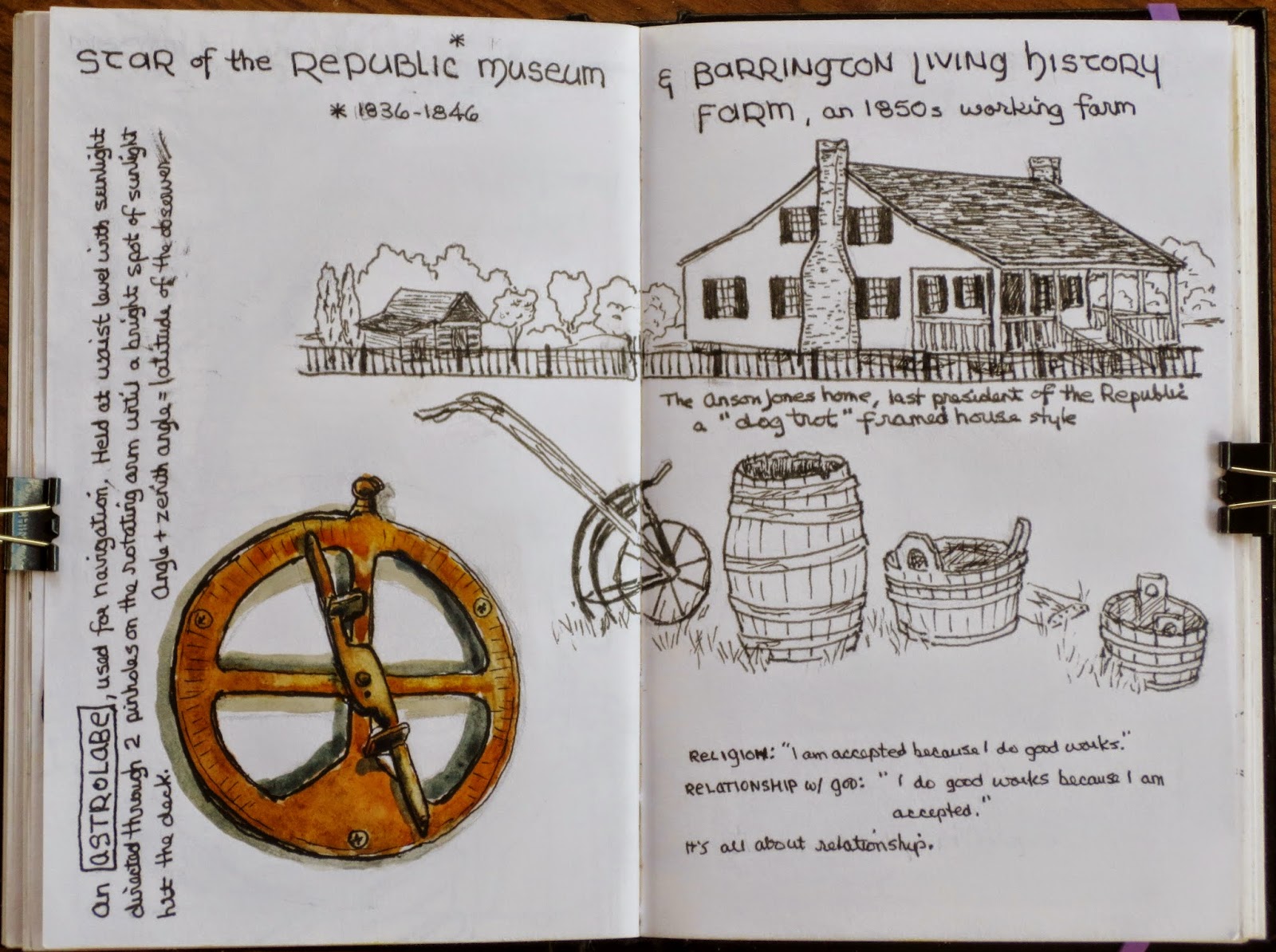
Recently we took our eldest granddaughter to see the museums located in Washington, Texas. In 1836, 59 delegates met here to establish the new Republic of Texas while defenders kept Santa Anna's army busy at the Alamo.

The unfinished frame building, a reproduction, is filled with tables laid end-to-end just as it was in 1836.

At the living history farm, interpreters depict life on an early cotton farm, where oxen are still used in the fields. I love the dog-trot framed house!

With a very humid 100° heat, I took photos to sketch later. I wanted to record these in my journal but it was just too hot to sketch on site.

After reading about astrolabes in a book, how cool to find one in the museum!

14 August 2013

mining salt under the Kansas prairie

It's always good to know the way UP and OUT.
On Saturday, we took our granddaughter Mikala, visiting from Texas, exploring the underground of Hutchinson, Kansas. One of the world's largest salt deposits was discovered there in 1887 (though I'm sure that Native Americans knew of it much earlier), spanning across Kansas, Oklahoma, the pan-handle of Texas, and into New Mexico. Still actively mined today, they also have a museum and visitors' center in one of the older sections of the mine.

We let Mikala ride in the front with Bill (sometimes she gets a bit queasy in cars). I sat in back, sketching her bucky pillow (filled with buckwheat hulls), and the two of them as they teased and laughed with each other.

Mikala looked cute in her hard hat.
Lots of hands-on exhibits showed how the salt deposits formed (when an ancient ocean covered this land), the variety of salt found here, and unusual formations such as fluid inclusions (pockets of ancient sea water trapped inside particularly pure specimens). Hard hats were required to be worn by all, as well as our being issued emergency breathing apparatus in case of fire . . . . even though salt can not burn.

Lots of discarded mining equipment was scattered about --- workers were told "what goes in the mine, stays in the mine", the company owners not wanting to tie up man-hours and equipment for hauling it out. Piles of lunch wrappers and other rubbish from previous generations of miners are now museum artifacts. At the end of the "dark ride" through the tunnels, we were able to choose some bits of salt as souvenirs. Mikala found the prettiest red salt sample, as well as a pure bit with a fluid inclusion inside -- we didn't discover the water bubble until later at home, holding it up to the light.


23 July 2013

20 July Sketchcrawl

This month, our sketchcrawl group met at Kansas City's Union Station --- busy place with a traveling Pirate exhibit from National Geographic, a local art exhibit, all the regular points of interest, and those actually traveling by train. We met under this huge clock, then dispersed in various directions to sketch.

Bill and I drove about 3 hours to get there, taking our youngest son, Jeff, with us --- he has been on summer break from college in Texas. On the way, we stopped for cups of coffee or tea.

I had my ceramic travel mug with me just in case -- love all things plaid! This one is made to look like a paper cup and has a silicone band and lid.

It was so crowded and noisy in the station, I eventually wondered into an old waiting room where several people were waiting for their trains. A much calmer room with these lovely antique lamps --- I wanted to also draw one of the antique benches but ran out of time. We had reservations to eat at the Harvey House, located right in the station.
Related Posts Plugin for WordPress, Blogger...